
CPA vs CFO AlternativeWho counts, and who decides.
.Most owner-run companies need the count and the decision, and can afford neither full time. Steven Palmieri holds that role.
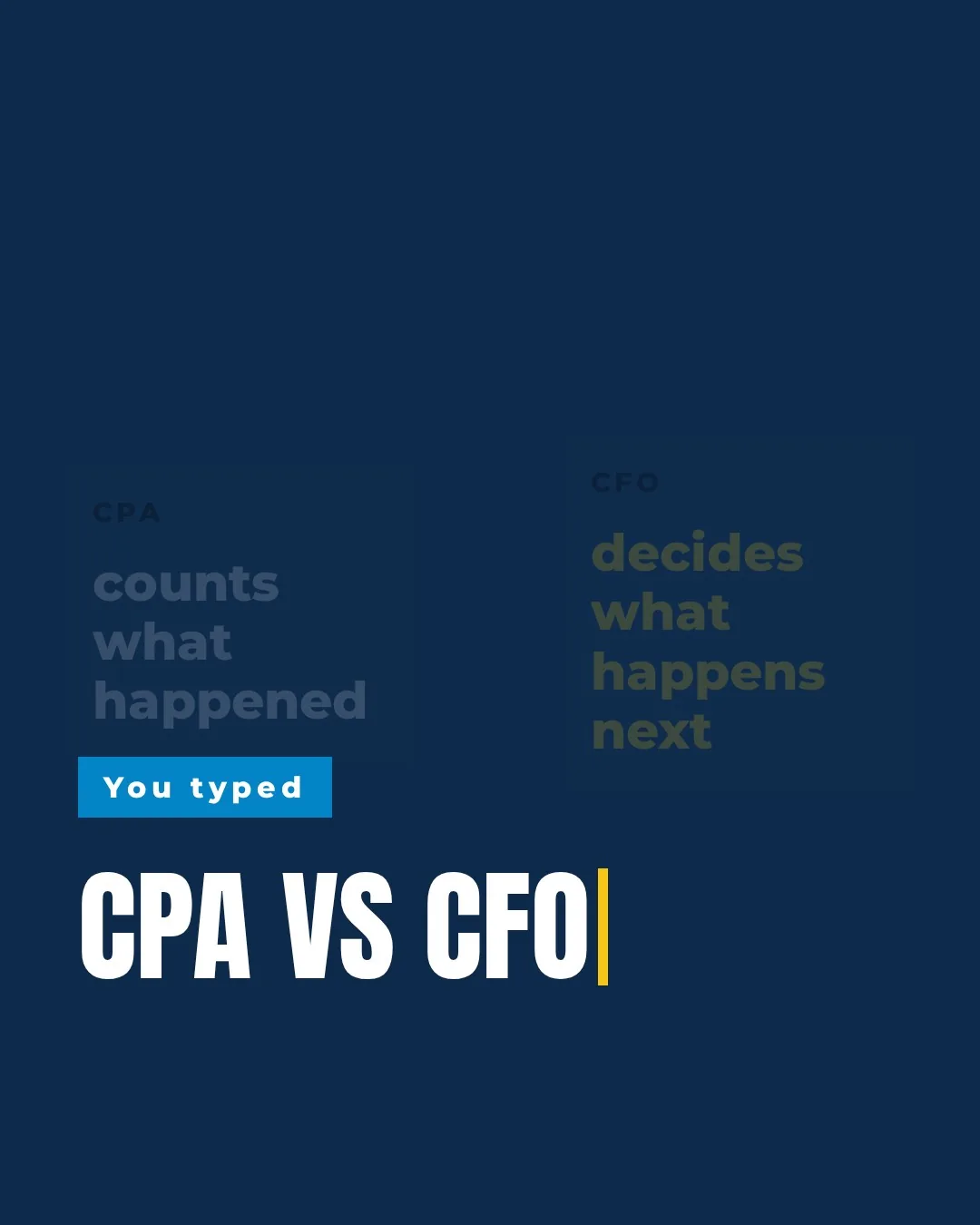
Name both titles
.A video call is enough. Carry the newest month you would defend, and the title you typed.

You will be talking to the Steven Palmieri practice.

What each title finishes
.The return, the decision, and both of them from one closed month.
Click to read both titles ›Tap to read both titles ›
What the license is for
.The license is for the signature on an audit, a review, or an opinion.
Click to see the license ›Tap to see the license ›
Both jobs at owner scale
.Both jobs are one week a month, not two hires.
Click to see owner scale ›Tap to see owner scale ›
October can still move
.March reads the year after it is done. October can still change it.
Click to read October ›Tap to read October ›
Picture a March meeting
.The scene is made up. No client name and no balance. The only lesson is the order of the work when nobody has named a title yet.
Click to picture March ›Tap to picture March ›
Why this address exists
.The two titles stay two jobs on this address. Now and then the honest result is that the words you typed asked for more help than the month needs.
Click to meet the practice ›Tap to meet the practice ›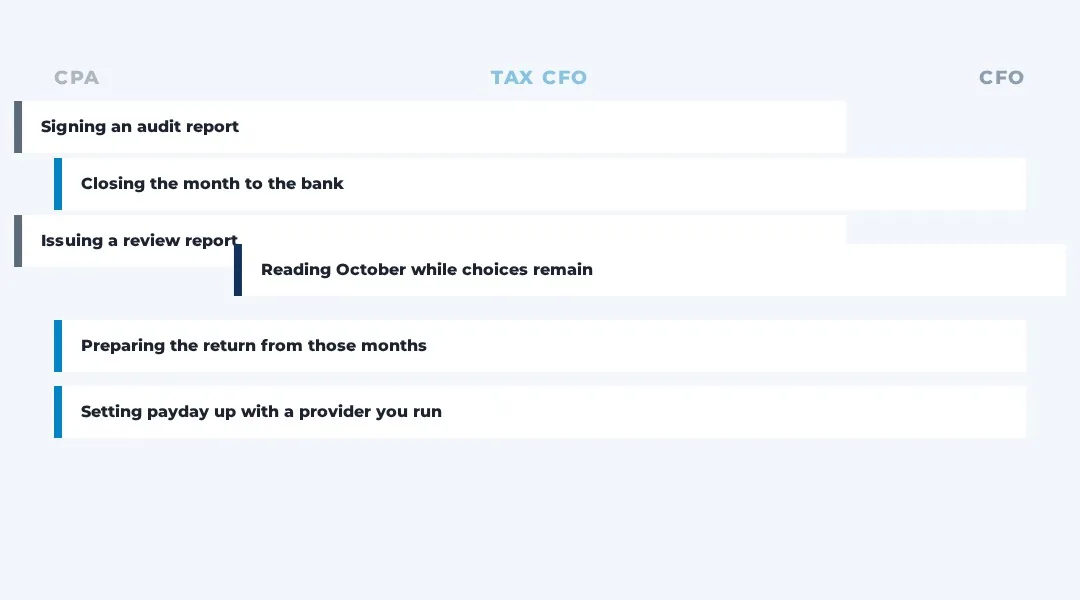
Six pieces owners mix up
.Each row already says where that piece of work lives. Open it, then mark it if you want.
1Closing the month to the bank Stays with us
The tie is ordinary work. A bigger title does not do the tie for you.
We keep this with the closed month and the return.
2Preparing the return from those months Stays with us
The return waits until deposits have names. A blank deposit keeps the year unfinished.
We keep this with the closed month and the return.
3Signing an audit report Needs a signer
That signature is the licensed job. It is not made in this practice.
A firm allowed to sign still makes this report.
4Reading October while choices remain Stays with us
Pay and a purchase can still change a year that is not over. After December they are a story.
We keep this with the closed month and the return.
5Issuing a review report Needs a signer
A review report is the same kind of signature as an audit. It leaves this practice.
A firm allowed to sign still makes this report.
6Setting payday up with a provider you run Stays with us
We arrange the setup. You keep running payday. The pay dates stay yours after that handoff.
We keep this with the closed month and the return.

Both finishes on this page belong to Steven Palmieri, the counting finish and the deciding finish.
Meet StevenBring the open month
.One month is enough to start. If neither title is the right hire, you will hear that plainly.
You will be talking to the Steven Palmieri practice.
Why the Tax CFO exists.
.
A tax preparer meets the year once, when the return is due. A corporate finance chief sits inside the company all year and draws a salary an owner-run company often cannot carry. Between those two sits a long stretch of months where the books are quiet, the decisions are live, and nobody is paid to look.
The owner in that stretch is usually doing between five hundred thousand and five million dollars of revenue. The company is real. If the company pays people, those wages already run on a service the owner picked and still operates. The year still needs a person who can close the month and decide the next one. Hiring both a once-a-year preparer and a full-time finance chief leaves a gap in the middle, and the gap is where October goes blank.
The Tax CFO is the role that closes that gap. Counting and deciding stay in one file, on one closed month. If you typed CPA vs CFO, we are the Tax CFO alternative for a company your size, and a licensed firm is only needed when a signature is required.
A CPA counts what happened and signs the return. A CFO decides what happens next and lives with the number. The Tax CFO is the one person who does the counting and the deciding in one file. The CPA finishes the return. The CFO finishes the decision. The Tax CFO finishes both from the same closed month. At owner scale the two jobs are one week of work a month, not two hires. That is the whole reason this title exists. A CPA sees the year in March. A CFO sees it in October, when your pay, a purchase and the company's shape can still change.
Two titles, not a contest.
.
People search both words because daily speech treats them as one anxious feeling. The feeling is usually a month that will not explain itself, a return that is approaching, or a year that can still be bent. Those are three different endings. Turning them into a rivalry spends the month you actually have.
In kitchen-table talk the first title means the person who prepares the return and, if a bank truly demands it, the person who signs a report on the statements. The second title means the person who reads cash, pay, and the shape of the year while a choice can still move the numbers. An owner can need both endings. Needing both is not the same as hiring a fight.
We stay with the records until the bank agrees with them. Every deposit is given a name, because one deposit might be a sale, a transfer between accounts, money you contributed, or a card payout that already had a fee removed. Unpaid bills remain visible on their own list. Money you took for yourself is parked on its own line, otherwise profit quietly eats a draw and pretends it was a cost. Wages get set up on a service the owner already runs, and after that setup this practice steps back. After that arrangement, we leave payday alone.
Once those pieces hold, the return can be prepared from them. Papers we put out stop short of an attest cover. If a lender or a buyer actually wants the signed report, that report goes to a firm allowed to sign it. We say so on the first call when that is the job sitting in front of us.
What October is for.
.
October is late enough that spring and summer are already written, and early enough that pay, a purchase, or the shape of an owner's draw can still change the year. Once December passes, those facts can only be retold. They can no longer be chosen. The number an owner should be able to say in October is the point of the second title. The return, which is what many owners meant by the first title, comes afterward and stands on those months.
State mail is easier to open when you have already walked the papers it sits on. You do not need a new title on the door to get that calmer feeling. It needs the close to keep its day when the shop is busy and when a cold week drops the temperature. The work is the month. Ask which label fits only after the month itself will stand up.
When the month is small and already true, hold onto your money. If every path on the page ended in a hire, the page would have stopped being a comparison. We would rather point you back to a month that already works than invent a second hire you do not need.
Where the reading goes next.
.
One page sets the two endings beside each other with no salary table and no revenue gate. Another page says what the license is actually for, and what it is not for. Another page is about owner scale, where both jobs land on one practice because a second vendor would leave October blank. October has its own page. So does a made-up March meeting with the amounts left off. Questions have two pages, one for the worry and one for the practical answers. A yearly report that a state asks of a company sits beside the two titles, and it still has to stand on a closed year. Owners in every state meet some version of that paper.
Carry one month. We will name which ending it is, and we will also say when the ending is none of them.
The license is for a signature, and it is not the close of your month, and it is not the choice about your pay. Steven and his team keep one company's closed month beside its return.